
New York Paycheck Calculator
Estimate your net paycheck after federal, state, and FICA taxes.
Your estimated bi-weekly take-home pay:
Where is your money going?
| Gross Paycheck | $0 | |
| Federal & State Taxes | 0% | $0 |
| FICA (SS & Medicare) | 0% | $0 |
| Pre-Tax Deductions | 0% | $0 |
| Post-Tax Deductions | 0% | $0 |
| Take Home Pay | 0% | $0 |
This calculator provides an estimate using simplified federal, state, and FICA formulas for general planning purposes only. It is not tax advice — actual withholding depends on your full tax situation. Consult a tax professional for exact figures.
What This Calculator Actually Shows You
A paycheck calculator takes your gross pay and works out what lands in your bank account. It accounts for federal tax, state tax, FICA, and local tax if you live in NYC or Yonkers. It works whether you’re paid a salary or an hourly wage.
New York paychecks look different from paychecks in most other states. That’s because on top of federal tax, you’re also paying one of the highest state tax rates in the country. If you live in New York City, there’s a third layer on top of that.
How a New York Paycheck Is Built
Gross Pay
Gross pay is what you earn before anything gets taken out. For hourly workers, it’s your hourly wage times hours worked, including overtime. For salaried workers, it’s your annual salary divided by the number of pay periods in the year.
Deductions, In the Order They’re Taken
- Federal income tax
- FICA (Social Security and Medicare)
- New York state tax
- NYC or Yonkers tax, if it applies to you
- Pre-tax deductions, like 401(k) or HSA contributions
- Post-tax deductions, like a Roth 401(k)
Net Pay
Net pay is what’s left after all of that. The formula is simple:
Gross pay minus taxes minus deductions equals net pay.
That final number is your actual take-home pay, the amount that hits your bank account on payday.
The W-4 Form and Your Paycheck
Every new job starts with a Form W-4. Your employer uses it to figure out how much federal tax to withhold from each check.
The IRS redesigned the W-4 in 2020, and the biggest change was removing withholding allowances. Instead of claiming a number, you now enter dollar amounts. The form walks you through five steps, but two matter most for your paycheck:
- Step 2: Check this box if you or your spouse have more than one job. It increases your withholding.
- Step 3: Enter a dollar amount for dependents. Multiply children under 17 by $2,000, and other dependents by $500.
- Step 4a: Report extra income that doesn’t have withholding on it already, like interest or dividends.
- Step 4b: Add any additional amount you want withheld from each check.
If your W-4 on file is from 2019 or earlier, you’re not required to update it. But if you do make any changes, you’ll need to use the new form.
Federal Payroll Taxes Explained
FICA Basics
FICA stands for Federal Insurance Contributions Act, and it covers two taxes: Social Security and Medicare.
- Social Security is withheld at 6.2%, up to the annual wage base limit.
- Medicare is withheld at 1.45%, with no income cap.
- Your employer matches both amounts, so the government actually collects double what shows up on your pay stub.
- If you’re self-employed, you pay both halves yourself, though you can deduct the employer portion when you file.
Additional Medicare Tax
High earners pay a bit more. Once your wages cross a threshold, an extra 0.9% Medicare surtax kicks in:
- Over $200,000 for single filers, heads of household, and qualifying widow(er)s
- Over $250,000 for married couples filing jointly
- Over $125,000 for married couples filing separately
This surtax isn’t matched by your employer. It only comes out of your paycheck.
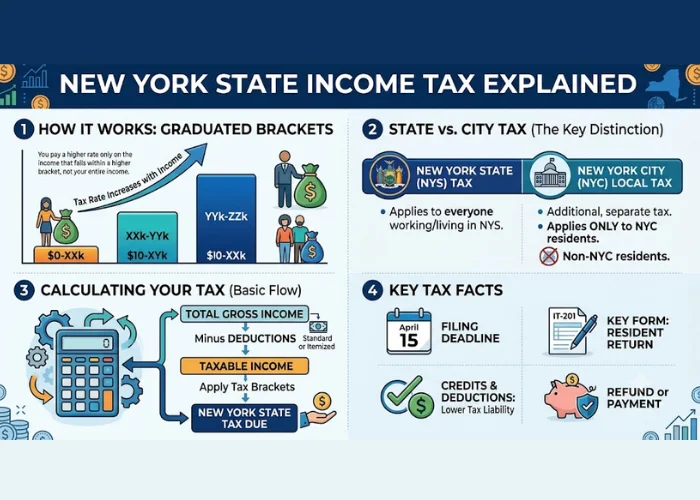
New York State Income Tax Explained
New York uses a progressive tax system, similar in structure to the federal one. There are nine brackets, and your rate climbs as your income does.
| Taxable Income | Rate |
|---|---|
| $0 to $8,500 | 4.00% |
| $8,500 to $11,700 | 4.50% |
| $11,700 to $13,900 | 5.25% |
| $13,900 to $80,650 | 5.50% |
| $80,650 to $215,400 | 6.00% |
| $215,400 to $1,077,550 | 6.85% |
| $1,077,550 to $5,000,000 | 9.65% |
| $5,000,000 to $25,000,000 | 10.30% |
| $25,000,000 and up | 10.90% |
That top rate of 10.90% only applies to income above $25 million, so it affects almost nobody. Still, New York’s overall rate structure puts it among the higher-tax states in the country, which is part of why so many people search for a paycheck calculator before accepting a job offer here.
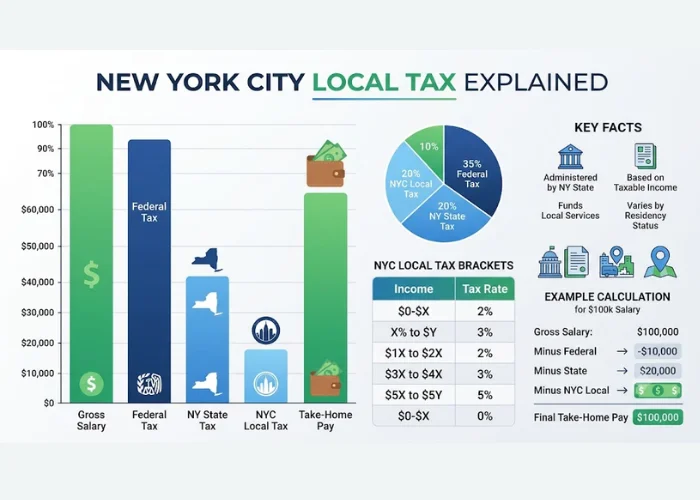
New York City Local Tax Explained
If you live in NYC, you pay a local income tax on top of state and federal tax, no matter where in the city you work. This is one of the two local taxes in New York, and it’s progressive too.
| Taxable Income | Rate |
|---|---|
| $0 to $12,000 | 3.078% |
| $12,000 to $25,000 | 3.762% |
| $25,000 to $50,000 | 3.819% |
| $50,000 and up | 3.876% |
These rates apply to single filers and married people filing separately. Married couples filing jointly and heads of household use the same rate structure, just with different income thresholds attached to each bracket.
Yonkers Tax
Yonkers is the other city in New York with its own local tax, and it works differently from NYC’s system.
- Residents pay 16.75% of their net state tax as an additional Yonkers tax.
- Non-residents who work in Yonkers pay 0.5% of their wages.
People moving to or from Yonkers are often surprised by this one, since it’s calculated as a percentage of your state tax rather than a flat bracket system.
MCTMT: The Tax Most People Never Heard Of
The Metropolitan Commuter Transportation Mobility Tax, or MCTMT, funds the MTA. It’s easy to miss because it mostly applies to self-employed workers, not regular employees.
Self-employed individuals in these areas may owe it:
- New York City
- Richmond County
- Rockland County
- Nassau County
- Suffolk County
- Orange County
- Putnam County
- Dutchess County
- Westchester County
The rate is up to 0.34% of net earnings. If you’re a W-2 employee, this doesn’t come out of your paycheck directly, your employer handles a version of it separately. But if you freelance or run a business in one of these counties, it’s worth budgeting for.
NYC vs Rest of New York State: A Side-by-Side Look
The same salary produces different take-home pay depending on where you live in New York. Here’s why.
Someone earning $80,000 a year in Buffalo pays federal tax, FICA, and state tax. Someone earning the same $80,000 in Manhattan pays all of that, plus NYC’s local tax on top. Over a full year, that gap can run into thousands of dollars.
This matters most for people considering a move within the state, or commuters weighing whether to live in the city or just outside it. Living outside NYC but working inside it doesn’t trigger the NYC tax, only residency does. Living in NYC does, regardless of where your office is.
Minimum Wage and Overtime Rules
Minimum Wage by Region (2026)
- $16.00/hour for most of the state
- $17.00/hour for New York City, Long Island, and Westchester County
Rates are reviewed periodically, so it’s worth checking current figures if you’re near the minimum.
Overtime Rules
Federal law (FLSA) requires 1.5 times your regular hourly rate for any hours worked past 40 in a week. So if you earn $20 an hour, your overtime rate is $30 an hour.
A few other rules that apply in New York:
- Meal breaks: a 30-minute break is required for shifts longer than 6 hours.
- Rest breaks: New York doesn’t mandate paid rest breaks by state law.
- Pay frequency for manual workers: weekly or semi-monthly, depending on the role.
Pay Frequency Explained
Pay frequency is how often you get paid, and it changes your gross pay per check even though your annual salary stays the same.
- Weekly: 52 pay periods a year
- Bi-weekly: 26 pay periods a year, or 27 during a leap year
- Semi-monthly: 24 pay periods a year, paid twice a month
- Monthly: 12 pay periods a year
People mix up bi-weekly and semi-monthly a lot. Bi-weekly means every other week, always on the same day, like every other Friday. Semi-monthly means twice a month on set dates, like the 1st and the 15th.
Here’s a quick example. A $52,000 salary works out to:
- $1,000 per week if paid weekly
- $2,000 per pay period if paid bi-weekly
- $2,166.67 per pay period if paid semi-monthly
Pre-Tax vs Post-Tax Deductions
Not all deductions work the same way, and the difference affects your taxable income.
Pre-tax deductions come out before taxes are calculated, which lowers the income you’re taxed on:
- 401(k) and 403(b) retirement contributions
- Health Savings Account (HSA) contributions
- Flexible Spending Account (FSA) contributions
- Many employer health insurance premiums
Post-tax deductions come out after taxes are already calculated:
- Roth 401(k) contributions
- Wage garnishments
One thing to watch with an FSA: unused funds mostly don’t roll over. Check your plan’s current rollover limit each year so you don’t lose money you already set aside.
Other Payroll Taxes You Might See
State Disability Insurance (SDI)
SDI replaces part of your wages if you can’t work due to injury or illness. In New York, the employer pays this one.
Family Leave Insurance (FLI)
FLI covers paid leave for an employee’s own health condition. In New York, the employee pays this through payroll withholding.
State Unemployment Insurance (SUI)
SUI funds unemployment benefits for workers who lose their jobs. In most states, including New York, the employer covers this cost. A few states, like New Jersey and Pennsylvania, require an employee-paid portion, but New York does not.
Bonus Pay: Different Tax Rules
Bonuses don’t get taxed the same way as your regular paycheck. They fall under what’s called the supplemental wage rate, which is often higher than your normal withholding rate.
This is why a bonus check can look smaller than expected. It’s not that bonuses are taxed more overall, it’s that more gets withheld upfront. Any overpayment usually balances out when you file your tax return.
Real Salary Examples: What You Actually Take Home in NYC
These are rough estimates for a single filer with no extra deductions, paid bi-weekly. Actual numbers shift based on filing status, deductions, and specific withholding choices.
| Annual Salary | Estimated Annual Take-Home | Estimated Monthly | Estimated Bi-Weekly |
|---|---|---|---|
| $50,000 | ~$38,500 | ~$3,210 | ~$1,480 |
| $60,000 | ~$45,300 | ~$3,780 | ~$1,740 |
| $70,000 | ~$52,000 | ~$4,330 | ~$2,000 |
| $80,000 | ~$58,600 | ~$4,880 | ~$2,250 |
| $90,000 | ~$65,000 | ~$5,420 | ~$2,500 |
| $100,000 | ~$71,300 | ~$5,940 | ~$2,740 |
| $110,000 | ~$77,500 | ~$6,460 | ~$2,980 |
| $120,000 | ~$83,600 | ~$6,970 | ~$3,210 |
| $150,000 | ~$101,800 | ~$8,480 | ~$3,910 |
| $200,000 | ~$130,500 | ~$10,880 | ~$5,020 |
These figures include federal tax, FICA, New York state tax, and NYC local tax. They’re estimates, not exact numbers, since real withholding depends on your specific W-4 setup and deductions. Married filers typically take home more at the same salary, since married brackets are wider.
Hourly Pay: Step by Step Calculation
Here’s how an hourly paycheck actually gets built, from first dollar to last.
- Calculate gross pay. Multiply your hourly rate by hours worked.
- Add overtime. Multiply overtime hours by 1.5 times your regular rate, then add it to gross pay.
- Subtract taxes. Federal tax, FICA, New York state tax, and NYC tax if it applies.
- What’s left is net pay. That’s your actual take-home amount.
Worked example: You earn $20/hour and work 40 regular hours plus 5 overtime hours in a week.
- Regular pay: 40 × $20 = $800
- Overtime pay: 5 × $30 = $150
- Gross pay: $950
- After federal, FICA, and state tax, take-home lands somewhere around $760 to $780, depending on filing status and location.
Hourly to salary conversion
Quick reference based on a standard 40-hour work week.
Hourly → Annual
Annual → Hourly
Figures are gross pay, before taxes and deductions. Based on 40 hours a week, 52 weeks a year.
Multi-State Work Situations
If you live in New York but work in another state, your taxes get more complicated. You may owe tax in both places, depending on reciprocity agreements between the states.
New York has limited reciprocity, so many cross-state workers end up filing in two states and claiming a credit in their home state for taxes paid elsewhere. Remote workers should also watch for nexus rules, since working from home in a different state than your employer can trigger tax obligations in both.
Self-Employed and Freelance Considerations
Freelancers and self-employed workers in New York carry a heavier tax load than employees, for a few reasons:
- You pay both the employee and employer share of FICA, since there’s no employer to split it with.
- MCTMT applies directly if you’re in NYC or one of the nearby counties.
- You’re generally expected to pay estimated taxes quarterly, rather than having tax withheld automatically.
A standard paycheck calculator built for W-2 employees will usually understate what a self-employed person actually owes.
How to Increase Your Take-Home Pay
A few adjustments can change how much lands in your account each payday:
- Update your W-4 if your refund is consistently too large or you owe money every year.
- Increase retirement contributions to a 401(k) or 403(b), which lowers your taxable income now.
- Use an HSA or FSA for medical expenses with pre-tax dollars.
- Ask about commuter benefits, especially useful in NYC where transit costs add up.
- Double check your filing status to make sure you’re not overpaying by using the wrong one.
Filing Status: Which One Applies to You
- Single: Not married, no dependents claimed under another status.
- Married filing jointly: Married couples combining income on one return.
- Married filing separately: Married couples filing individual returns.
- Head of household: Unmarried, paying more than half the cost of a household with a qualifying dependent.
Head of household status usually means wider tax brackets and a lower effective rate than filing single. But the rules around who qualifies are specific, so it’s worth confirming before you select it. Choosing the wrong status can cost time and money later.
A Note on Accuracy
This calculator and article give general estimates based on published tax rates and standard payroll formulas. They’re not a substitute for tax or legal advice. Actual withholding depends on your full financial picture, including deductions, credits, and any additional income. For exact numbers, talk to a tax professional or accountant.